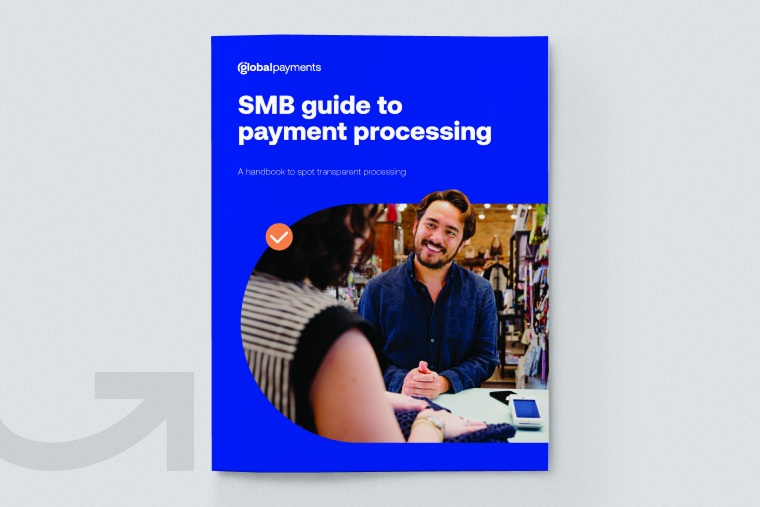
Choosing a payment processor doesn’t have to be a headache
Accepting credit cards seems simple. A customer taps, inserts or swipes and the payment goes through. But behind every transaction is a network of banks, card brands and service providers — each playing a role in how the payment is processed and what it costs.
From processing fees to pricing structures, you deserve to know how payment processing works and how to tell if what you’re paying is fair.
In this blog, we’ll break down the core fee types, explain the most common pricing models and help you compare options so your small business can get paid simply, securely and quickly.

Three main types of processing fees small businesses will encounter
You’re paying a payment processor to accept credit cards. All of the money goes to them, right? Not so fast. When you accept credit cards, you’re not paying one single rate. You’re paying several types of fees. Most processing expenses fall into three main categories:
1. Interchange fees
Interchange fees go to the card-issuing bank and typically represent the largest portion of processing costs — usually around 70% to 85% of the total. They are set by the card brands and are non-negotiable for merchants or processors.
2. Dues and assessments
Dues and assessments are charged by the card brands to cover the operating costs of managing their networks. Assessments are generally flat-rate percentages applied to total gross monthly sales, while dues are often smaller per-item transaction fees charged per authorization.
3. Processing fees
Processing fees are what your payment processor charges for providing access to the authorization network and for services such as PCI compliance assistance and EMV capabilities.
While interchange and card brand fees are non-negotiable, you can control the processor and pricing structure you choose. That’s why transparency is so important when selecting a provider.

Four common pricing structures for processing fees
Now that you understand the main types of processing fees, the next step is seeing how those fees are structured within different pricing models.
1. Interchange-plus pricing
Also known as cost-plus pricing, this model charges the interchange rate plus a fixed processor markup.
- Pro: Often makes it easier to compare rates between processors
- Con: Not all businesses qualify for this type of processing
2. Flat-rate pricing
Flat-rate pricing bundles interchange and processor fees into a single rate.
- Pro: Simple, predictable fee structure
- Con: Interchange and processor markup aren’t itemized, making it harder to comparison shop
3. Tiered pricing
An older processing model, tiered pricing groups transactions into categories, each with its own rate based on factors like card type and transaction risk level.
- Pro: May help some businesses save money, depending on how transactions qualify
- Con: Harder to predict total costs, since rates vary based on the types of cards customers use and how transactions are classified
4. Subscription and membership pricing
This structure is a variation of interchange-plus pricing and typically includes a monthly membership fee plus a flat per-transaction fee.
- Pro: Offers a simplified view of interchange-plus
- Con: Monthly fees can add up fast
No single pricing structure is right for every business. Your best option will ultimately depend on factors such as transaction volume, average ticket size, customers’ card types and your payment environment.
Get the full SMB guide to payment processing

Security and compliance considerations for your small business
Price matters, but so does protection. When you accept card payments, you’re taking on responsibilities for safeguarding cardholder data and reducing fraud exposure — and the processor you choose can make that easier (or harder).
Look for a processor that provides:
- Point of sale equipment that meets Payment Card Industry Data Security Standard (PCI DSS) requirements for technology applications
- Encryption of card data during transactions
- Tokenization of stored card data
- EMV-enabled hardware and chip card acceptance for more secure in-person payments
A good processor won’t just help you take payments — they’ll help you meet security requirements and support ongoing compliance through the equipment and payment technology they provide.
Questions to ask potential payment processing providers
In addition to clarifying security and compliance support and pricing structures and fees, it’s important to ask some key questions when deciding which payment processor to partner with.
If you’re wondering how to identify the best credit card processor for your business, consider:
- What is the contract length?
- What hardware would I need?
- What security options are available?
- How long do payouts take?
- What kind of customer support do you offer?
- Are any tax benefits supported, especially regarding compliance and reporting requirements for my business?
Payment tech is an investment, so take the time to ask questions and really get to know your processor.
Choose a payment processor that actually makes getting paid easier
There’s a lot that goes into choosing a payment processor. As you evaluate options for your small business, keep your focus on what matters most — your goals and your customers’ needs.
Look for a partner that can offer:
- Transparent payment processing that gives you the insight needed to manage costs
- Secure payment technology that supports your day-to-day operations and helps protect your business
- A pricing structure that aligns with how you accept payments and how your customers pay
Get the full SMB guide to payment processing