How to turn drive-thru bottlenecks into growth opportunities
How to turn drive-thru bottlenecks into growth opportunities
Every second counts in the drive-thru lane. When guests wait too long or receive incorrect orders, they take their business elsewhere. According to our latest QSR study, 92% of respondents said they would leave a line heavy with cars. For enterprise QSR operators, these friction points can cost millions in lost revenue.
Drive-thru accuracy has slipped to 87% industrywide, down from 89% just a year ago, according to QSR Magazine’s 2025 report. Average service time now hovers around five and a half minutes. Meanwhile, drive-thru traffic has declined 5–8% year-over-year as consumers opt for online orders, takeout and delivery.
Yet the drive thru remains the most valuable revenue generator. In our study, 54% of respondents said the drive thru is their most-used way of ordering food.
What works in practice… and what doesn’t
What works in practice… and what doesn’t
Drive-thru performance often breaks down in the same predictable ways. These scenarios show what happens when decisions about lanes, staffing and tools don’t match how the rest of the operation runs.
The dual-lane misconception
Many operators assume adding a second lane automatically doubles throughput. Without the right staffing and coordination, the second lane can create confusion instead. Staff struggle to match orders with cars, especially when mobile and drive-thru orders mix. The result is an underused second lane and frustrated guests.
The speed of friendly service
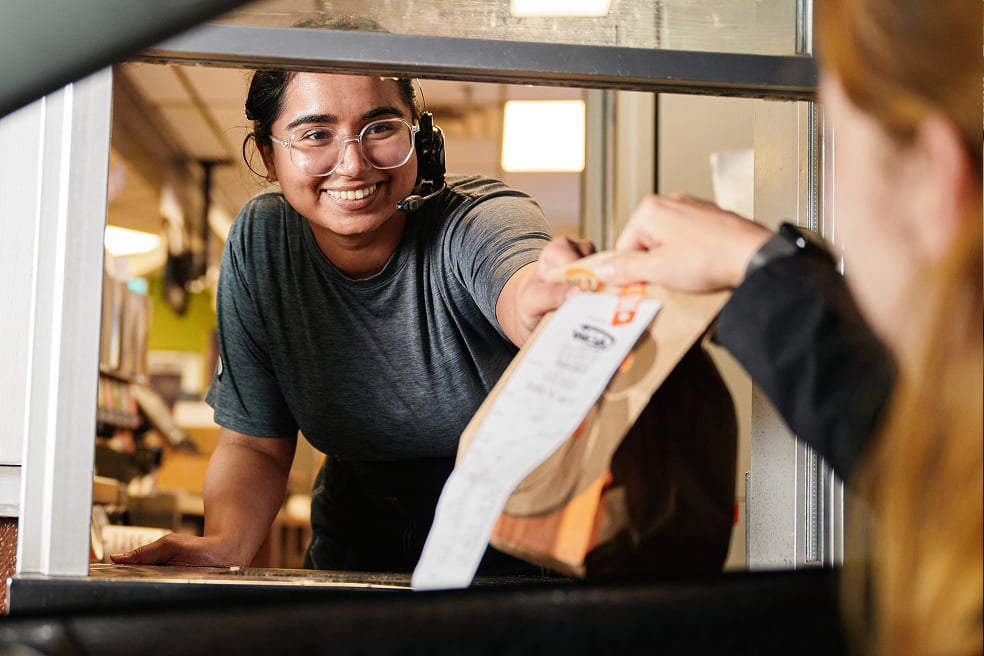
When employees deliver friendly service, drive-thru times average around five and a half minutes. When employees are not friendly, that average time jumps to almost seven — nearly two minutes longer. Pushing for speed without training staff on customer interaction can slow everything down.
Workflows for order confirmation boards
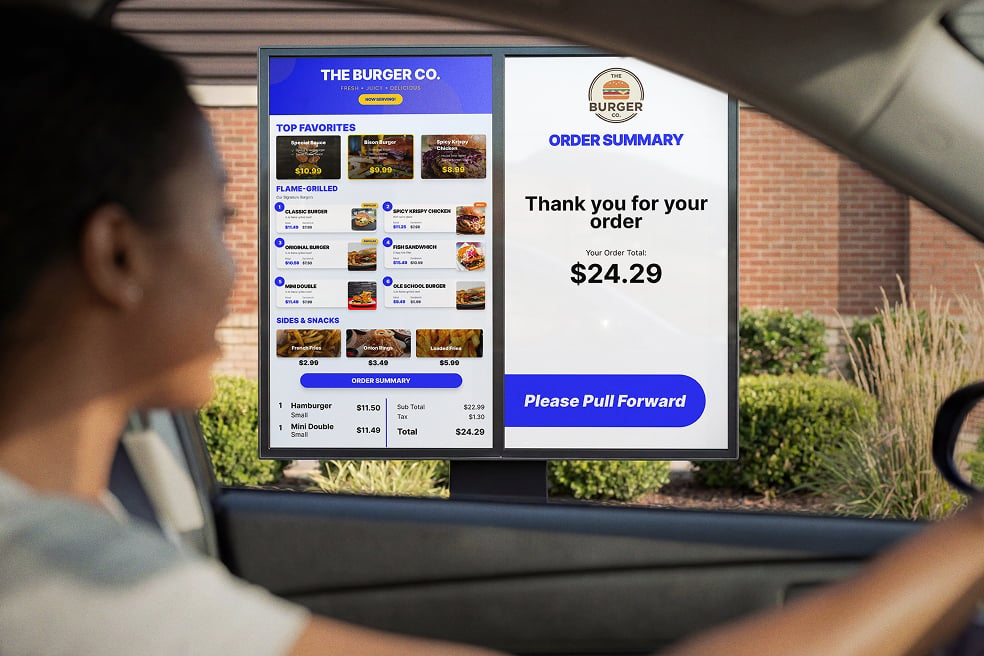
Accuracy rates jump 26 percentage points when order confirmation boards display information correctly. The common failure? Implementing the hardware but not the workflow. Staff must confirm orders on the screen before guests pull forward, or the board becomes another source of confusion.
When drive-thru optimization makes sense
When drive-thru optimization makes sense
The biggest mistake operators make is treating drive thru as a standalone problem. Your drive thru is only as good as your kitchen’s ability to fulfill orders. Optimizing isn’t possible when those systems don’t communicate.
Not every location faces the same challenges. A recent Global Payments survey found that budget is a top barrier to improving technology, with integration complexity close behind. That is why it’s critical to view drive-thru performance in the context of the whole operation — kitchen flow, staffing, digital channels and existing systems — before deciding where to invest. Consider these steps.
- Assess the problem when waits at busy locations exceed four minutes at peak, when accuracy falls below 90% or when digital orders regularly collide with in-person traffic at the window.
- Confirm readiness by making sure you have the people, time and training capacity to roll out new processes across kitchens, drive-thru staff and franchise locations.
- Fix bottlenecks first by addressing kitchen and routing issues before adding new ordering channels. If your kitchen cannot keep pace with current orders, adding kiosks or mobile ordering only adds to delays.
- Choose upgrades that connect drive thru, kitchen and digital channels — such as unified POS, kitchen display systems, digital menu boards or drive-thru automation — so gains in one area are supported by the rest of the operation.
The economics of getting it right
The economics of getting it right
Technology investments need to deliver measurable returns. Digital menu boards that sync with real-time inventory data can boost check sizes and reduce waste. Self-service kiosks can speed up service and boost profitability. These gains only materialize when the technology ties into existing systems.
Fragmentation is a real problem. Around 32% of operators cited outdated POS systems as a top concern for staying up and running during disruptions. When systems don’t talk to each other, delivery and mobile orders may not reach the kitchen on time, menu changes may not show up on every screen and staff are left to sort out order mix-ups at the window.
Operators are solving this by choosing unified platforms that bring together point of sale, kitchen management, drive thru and ordering in one system. When a customer places a mobile order, the system routes it based on current kitchen load and priorities. Digital displays pull from the same menu, ensuring consistency. Changes sync instantly across hundreds of locations.
Restaurants using integrated drive-thru solutions may reduce average service time by a matter of seconds. But at high-volume locations, those seconds compound into measurably higher throughput and revenue.
Building for what comes next
Building for what comes next
Operators often ask whether they should invest in new technology or fix their kitchen first. The answer depends on where your bottleneck is. If your kitchen is already struggling, investing in faster order capture just puts more pressure on a system that can’t handle it. If your kitchen feels ready to go, it’s time for a look at your tech stack to evaluate its ability to scale and integrate across solutions in your restaurant.
The strongest returns come from platforms that support three things:
- The ability to add new features without replacing everything
- Integration with different partners and vendors
- Cloud-based architecture that enables rapid updates across all locations
The drive thru will remain central to quick service operations. As technology evolves, the gap between brands that align drive thru, kitchen and digital channels and those that do not will widen. Operators who invest in connected, flexible platforms today put their brands in a stronger position for whatever comes next.
See how customer expectations are reshaping QSRs
Source: Global Payments survey