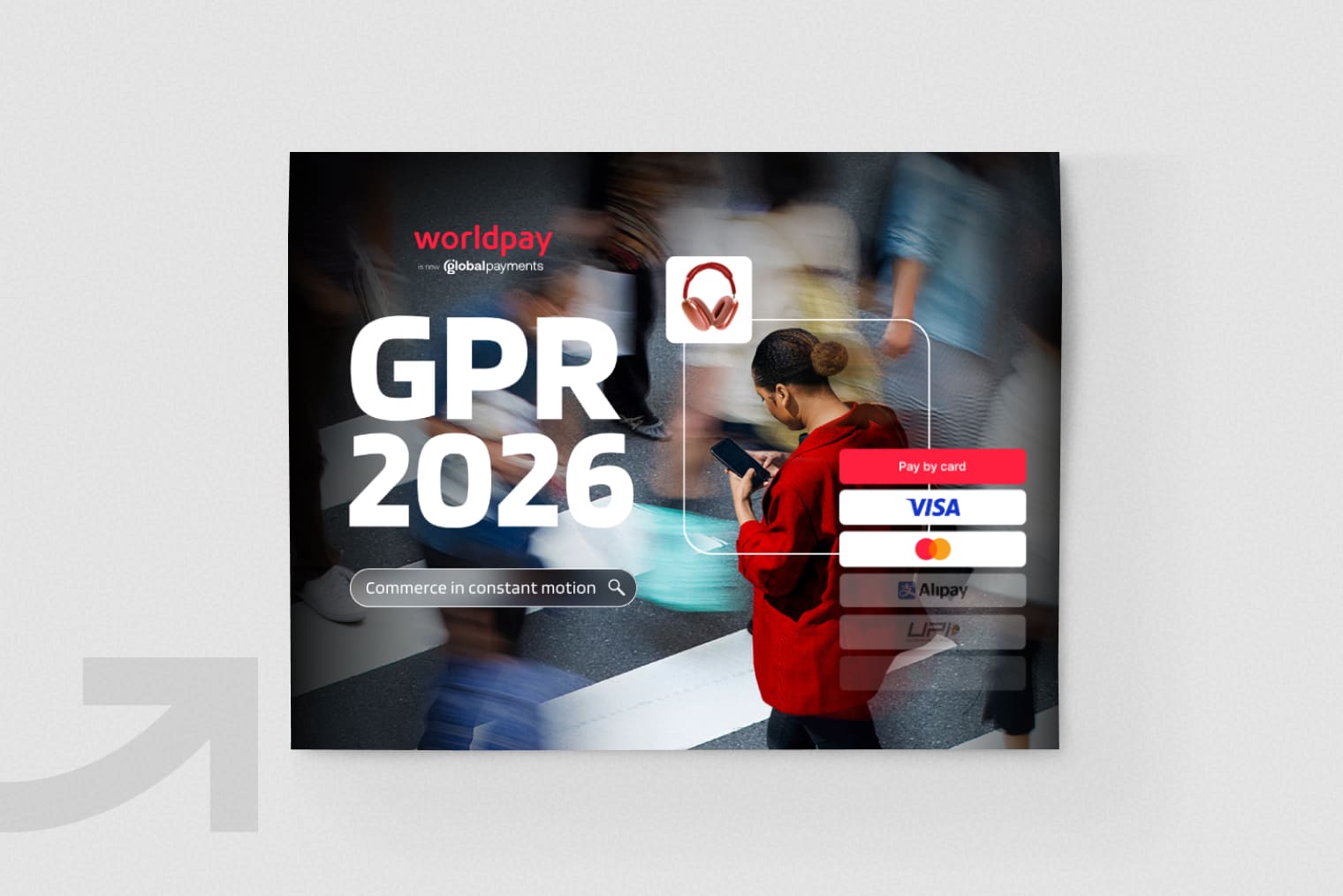
Global Payments Report 2026: the trends redefining payments
- Payment apps are on track to power 46% of global POS value by 2030, worth $15.6 trillion.
- “Glocalization” is reshaping cross-border commerce: consumers expect their local payment methods to work everywhere.
- Digital wallets now account for 56% of global ecommerce value and 33% of in-store spending.
- Buy now, pay later (BNPL) is forecast to hit $500 billion in global ecommerce value by 2030.
- Crypto remains a developing payments story, with stablecoins showing the clearest potential for cross-border use cases.
- All of this, across 42 markets, in one report.
What’s the GPR all about?
The 11th annual Global Payments Report (GPR), produced by Worldpay, now Global Payments, tracks consumer payment preferences across 42 key markets, as well as the forces shaping where payments are headed.
Polling 63,000 consumers on how they pay, the GPR is widely recognized as the leading authority on global consumer payments.
This year’s theme, “commerce in constant motion,” captures a payments landscape shaped by changing consumer expectations and evolving payments infrastructure.
Local systems, new technologies and consumer habits are creating multiple routes to the same goal: faster, easier and more familiar payments.
We see different payment trends taking off in different markets. For merchants, it’s important to understand the optimal payments mix that gets consumers through the checkout easily and keeps them coming back.
This year’s key payment trends
1. Payment apps are heading to stores
The physical checkout is finally catching up with online. Driven by QR code adoption in APAC and LATAM, open NFC (near-field communication) regulation in Europe, and the smartphone’s central role in daily life, payment apps are no longer alternatives. They are on track to power 46% of global point-of-sale (POS) value by 2030.
Explore what’s driving the in-store shift →
2. Glocalization: your customers expect their wallet to travel
Many payment systems were built for domestic use, which is a problem if your customers aren’t staying home. China’s Alipay, India’s UPI and Brazil’s Pix are extending their reach across borders.
In Southeast Asia, real-time payment networks are linking up. In Europe, Wero is working to unify fragmented systems.
Friction at the cross-border checkout is becoming a competitive liability, but a multipolar payments world is starting to take shape.
3. Digital wallets are becoming the everything method
Apple Pay, Alipay, PayPal: digital wallets now dominate both ecommerce and in-person spending. Their power is in their flexibility: they can fund transactions via cards, A2A, BNPL or stored value, adapting to what each market needs.
Globally, digital wallets accounted for 56% of online and 33% of in-person spending in 2025, making them the world’s leading way to pay. One method, many shapes.
Get the latest on digital wallets →
4. BNPL is growing and evolving
Buy now, pay later isn’t just growing; it’s expanding its footprint. What started as interest-free short-term financing at checkout is now moving into card issuing, savings products, A2A, rewards and shopping platforms. Adoption is rising across age groups and sectors. By 2030, BNPL is forecast to account for $500 billion of global ecommerce value.
5. Crypto: gradual, not sudden
Direct crypto payments remain niche (0.19% of global transaction value), but crypto-to-card services are widening real-world usage well beyond the headline figure.
Meanwhile, stablecoins are quietly becoming a credible tool for cross-border payments as regulatory frameworks improve and merchant confidence grows.
The complete guide to consumer payments
For merchants wishing to expand across borders, getting payments right is about understanding what your customers expect in each market. The GPR provides the data, trends and forecasts to make decisions with confidence across 42 markets, broken down by region, method and trajectory to 2030.
The complete guide to consumer payment preferences, market-by-market breakdowns and the trends shaping commerce.