
How interchange payment processing works
When accepting payments for invoices as big as yours, you should expect to be raking in the revenue. So what gives? It’s possible interchange fees are eating into your margins.
An interchange fee is charged by card-issuing banks to cover the basic processing costs of each transaction. The fees are determined by:
Processing method: Card-present or card-not-present transactions have different risk levels and interchange rates
Card type: Credit and debit cards have different categories and rewards programs
Card owner: Corporate cards and multi-person use accounts affect the category of fees
Card brand: The brand of a bankcard can impact interchange fee
Each of these card details results in different levels of interchange fees that are passed on to you, the business owner. To simplify the cost, credit card companies sometimes compute interchange rates into a flat rate plus a percentage of the sales total.
If your pricing structure isn’t very transparent when it comes to interchange fees, you could be losing out on cash flow without ever realizing it. These fees are non-negotiable, and you have minimal control over them, but adding Level 2 and Level 3 processing capabilities can help kickstart your interchange optimization.
Adding Level 2 and Level 3 card data can help reduce the cost of transactions, particularly those involving commercial, corporate and purchasing credit cards reducing the interchange rate you pay.
What is Level 2 credit card processing?
When a transaction occurs, specific data is included with the transaction that helps the authorization network determine the level of risk the transaction represents. The more data that is included, the less risk, the lower the rate. Credit card companies offer lower rates for credit card processing as an incentive for lower-risk transactions.
Level 2 processing must include the following information:
- Sales tax amount
- Customer reference number or purchase order number
- Merchant ZIP code
- Credit card number
- Expiration date
- Transaction amount
- Merchant name
- CVV

What is Level 3 credit card processing?
With Level 3 processing, you get an even deeper look into the transaction.
To qualify as Level 3 data, you need all the same details as Level 2, plus:
- Item descriptions and product codes
- Quantities and unit prices
- Freight and shipping costs
- Discount amounts
- Invoice number
Trim your rates. Keep more revenue.
Get a big-picture view of potential hidden savings and start protecting your margins with our free interchange pricing calculator. This easy-to-use tool crunches the numbers for you so you can get back to running your business flawlessly — and ditch unnecessary fees.
Unlock additional savings with large tickets ($10k+). Talk to our team to validate your estimate.
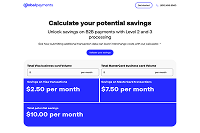
Run the numbers with our calculator
How interchange optimization improves cash flow and profit margins
The bottom line? The more transaction information you can provide, the more your interchange fee rates will decrease. This is great for B2B payment optimization since your interchange fee amount drastically eats into the revenue on your larger invoices.
Key interchange optimizations with our B2B solutions:
Lower processing costs
Automatically reduce interchange rates with Level 2 and 3 data that give card networks additional information about a transaction.
Fewer chargebacks
Mitigate chargebacks and protect your revenue with digital invoicing that prompts for payment and decreases the risk of unfamiliar transactions.
*Figures are illustrative and don’t represent a quote or commitment. Complete the form for a personalized quote.
©2026 Global Payments Inc. All trademarks and service marks contained herein are the sole and exclusive property of their respective owners.